Hair Trimmer Size Guide
Trimmer combs are labelled in millimetres, clipper guards in numbers, and beard styles in vague words like “heavy stubble”. This guide ties them together: choose the look you want and get the setting, how long to grow it and how often to trim to keep it there.
- Free to use
- No sign-up
- Runs in your browser
Trimmer setting planner
Zone settings
Beard Trimming Guide Pack
Printable trimmer length chart with guard equivalents, a beard zone settings card, a stubble growth and trim schedule tracker and a neckline guide.
- Length chart (PDF/DOCX)
- Guard to mm (PDF/DOCX)
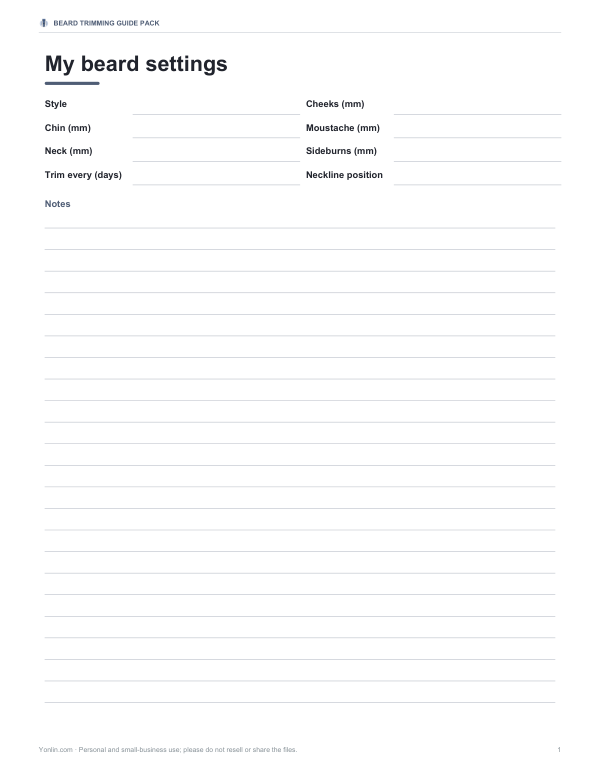
- Zone card (PDF/DOCX)
- Trim tracker (PDF/DOCX/XLSX)
Formats: PDF, DOCX, XLSX. Instant download after payment (link valid 72 hours, up to 5 downloads). AI-assisted: the templates were drafted with AI help and reviewed and laid out before publishing.
$3.00 USD, one-time 4 files · about $0.75 each
- Instant download
- 7-day refund
- Secure checkout by Stripe
7-day money-back guarantee. Full refund within 7 days of purchase, even after you download.
Free sample: Guard to MM (PDF, 101 KB)
Full refund within 7 days — see the refund policy and license.
Free printables
Single sheets you can print right now, no sign-up. The full pack adds every sheet in one download plus the editable files.
 Printable Beard Trim Tracker
Beard and stubble lengths
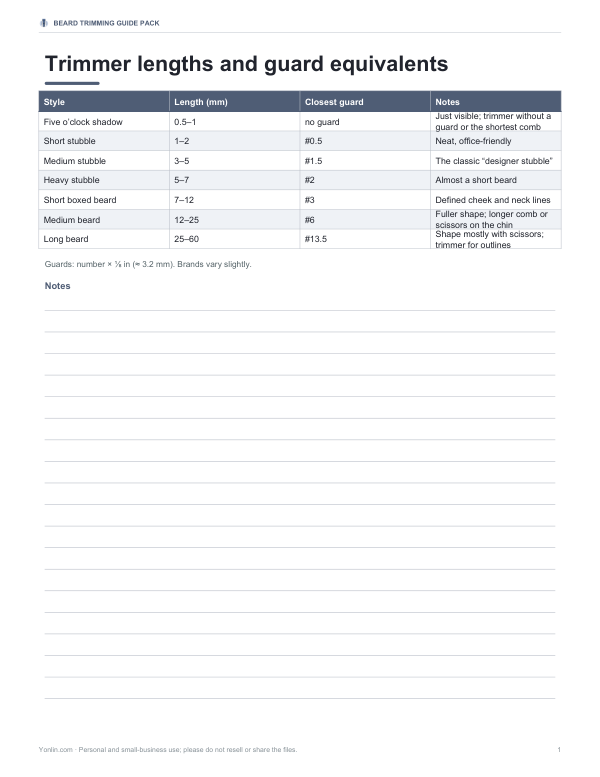
| Style | Length | Closest guard | Notes |
|---|---|---|---|
| Five o’clock shadow | 0.5–1 mm | no guard | Just visible; trimmer without a guard or the shortest comb |
| Short stubble | 1–2 mm | #0.5 | Neat, office-friendly |
| Medium stubble | 3–5 mm | #1.5 | The classic “designer stubble” |
| Heavy stubble | 5–7 mm | #2 | Almost a short beard |
| Short boxed beard | 7–12 mm | #3 | Defined cheek and neck lines |
| Medium beard | 12–25 mm | #6 | Fuller shape; longer comb or scissors on the chin |
| Long beard | 25–60 mm | #13.5 | Shape mostly with scissors; trimmer for outlines |
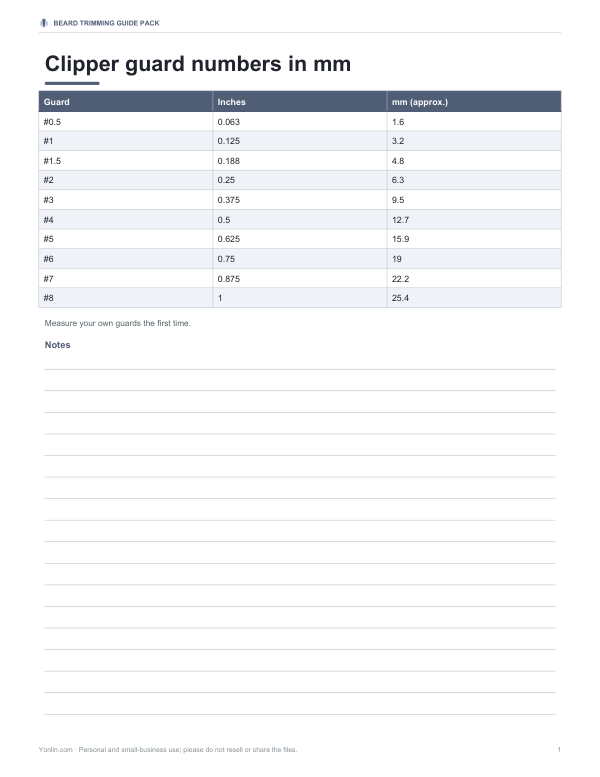
Clipper guards are numbered in eighths of an inch (#1 = ⅛ in ≈ 3 mm, #2 = ¼ in ≈ 6 mm), while most beard trimmers use combs or dials marked in millimetres, often in 0.5 or 1 mm steps.
How long does stubble take to grow?
Facial hair commonly grows somewhere around 0.3–0.5 mm a day, and this guide uses 0.4 mm as a starting point. At that rate, short stubble (1–2 mm) takes about 3–5 days, medium stubble (3–5 mm) about a week to 12 days, and a short boxed beard (7–12 mm) around three to four weeks. Many people find their hair grows unevenly — cheeks slower than the chin and moustache — which is exactly why trimming to a set length helps.
Worked example
Someone wants medium stubble. The planner suggests 4.0 mm, roughly a #1.5 clipper guard. Four days after a clean shave, at 0.4 mm a day, the stubble is about 1.6 mm, so it takes about 4 more days to reach the 3 mm lower end of the range before the first trim. Allowing 1 mm of extra growth before it looks untidy, they trim every 2 days, keep the neck below the jaw at 1 mm or shaved, and tidy the sideburns a millimetre shorter.
Choosing a trimmer
- Look for a length range that covers your style, with fine steps (0.5 mm) for stubble.
- An adjustable dial is quicker than swapping combs; separate combs can be sturdier.
- A narrow detail head helps with lines around the lips and nose.
- Wet-and-dry models can be used in the shower and rinsed clean.
- Check battery run time and whether it can run while charging.
Trimming technique
- Trim dry, clean hair — wet hair lies flat and looks longer.
- Start with a longer setting than you think; you can always go shorter.
- Move against the direction of growth, with the comb flat against the skin.
- Define the neckline about two fingers above the Adam’s apple.
- Tidy the cheek line with the bare trimmer or a razor.
- Clean the blades and oil them regularly.
Stubble maintenance through the week
| Day | Short stubble (1–2 mm) | Medium stubble (3–5 mm) |
|---|---|---|
| Mon | Trim at 1.5 mm, clean neck | Trim at 4 mm, clean neck |
| Tue | — | — |
| Wed | Trim at 1.5 mm | — |
| Thu | — | Trim at 4 mm |
| Fri | Trim at 1.5 mm, tidy cheek line | — |
| Sat | — | Neck and cheek lines only |
| Sun | Rest or trim | Trim at 4 mm |
The shorter the style, the more often it needs trimming, because the same daily growth is a bigger share of the length. A week of growth doubles short stubble but only adds about a quarter to a short beard.
Skin care and irritation
Trimmers cut above the skin, so they cause less irritation than razors, but very short settings and dull blades can still pull. Keep blades clean and oiled, don’t press hard, and use a gentle cleanser and moisturiser on the skin under stubble. For ingrown hairs on the neck, a slightly longer setting or trimming instead of shaving often helps. Anyone with a persistent rash or infection should see a doctor or dermatologist.
Measuring your own growth rate
To personalise the planner, trim to a known setting — say 2 mm — and after three or four days measure a few hairs on the cheek and chin against a millimetre ruler, or try longer combs until one just skims the tips. Divide the growth by the number of days and enter it as your growth rate. Many people find the moustache and chin grow noticeably faster than the cheeks, so a slightly shorter setting on those zones keeps the whole beard even.
Head hair with a trimmer
Trimmers can also tidy short haircuts, but clippers with larger blades are quicker for heads. To match a barber’s cut, convert their guard number to millimetres (number × 3.2 mm, approximately) and set your trimmer to the same length. Guard sizes vary slightly between brands, so check with a ruler the first time.
Privacy
Everything runs in your browser.
Frequently asked questions
What trimmer setting is stubble?
About 1–2 mm for short stubble, 3–5 mm for medium and 5–7 mm for heavy stubble.
How many mm is a #1 guard?
About 3 mm (⅛ inch); #2 is about 6 mm.
How fast does beard hair grow?
Often around 0.3–0.5 mm a day, varying between people.
How often should I trim stubble?
Every 2–3 days for short stubble to keep the length consistent.
Should I trim wet or dry?
Dry, so you see the true length.
Where should the neckline be?
About two fingers above the Adam’s apple, curving up toward the ears.
What length is designer stubble?
Usually about 3–5 mm.
Can I use a beard trimmer on my head?
Yes, for short cuts; set it to the barber’s guard length in mm (guard number × about 3.2 mm).